

We need to talk about THAT poem by Renee Nicole Good
and how it sets her apart from the men who would tear her down

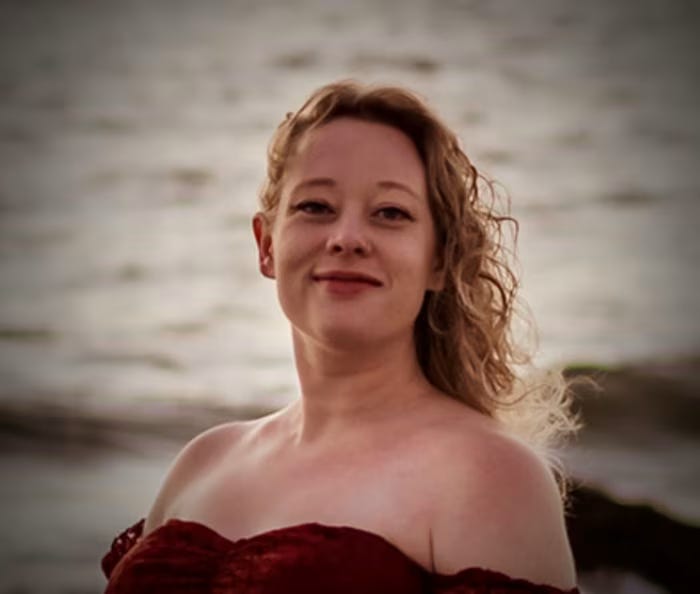
I’m sure Renee Nicole Good wrote lots of poems.
In the bio of her private Instagram account, she called herself a “poet and writer,” as well as a “shitty guitar strummer,” so it feels safe to say that, before a masked man shot her down in the street earlier this week, art was a central part of her life.
The thing about art is that we often don’t get to decide when it reaches anyone, or under what circumstances.
It’s hard to imagine shittier circumstances than these.
There is, however, a small miracle cracking through the charred surface of this grief, which is that in 2020, when most of us were playing Animal Crossing and trying to find a grocery store that wasn’t out of flour and toilet paper, Good was winning an American Poets Prize.
Her poem, “On Learning to Dissect Fetal Pigs,” is only 34 lines long, some of them as brief as a single word, and it packs a fucking devastating punch in the wake of the reason why we’re all finding it now.
In my first read through, some of the early images slipped past me and I had to go back and read them again. I googled “solipsist” and then “tercets,” and wondered if what she had to say was going to land with me. But then I read it again. And again. And suddenly, like the poems written by the masters I studied in college, it opened for me. It slipped into place. The poem did for me what poems are supposed to do.
She talks about studying a high gloss biology textbook “under clippings of the moon at two forty five AM” at an IHOP, burning key words into her memory, repeating and scribbling “until it picked its way & stagnated somewhere i can’t point to anymore.” She describes the feeling of being silently torn between the faith that used to feel so close and comforting (and maybe still can be?) with the hard scientific reality of her world.
“maybe there in-between my pancreas & large intestine,” she says, “is the piddly brook of my soul.”
She wants to believe in something. She wants to find connection to faith, and to a purpose larger than her understanding. But maybe the disconnect is too strong? “now i can’t believe—,” she continues in the next line, “that the bible and qur’an and bhagavad gita are sliding long hairs behind my ear like mom used to & exhaling from their mouths ‘make room for wonder’—”
And her words were powerful enough for someone behind some desk in 2020 to immortalize them.
But now?
Knowing how her life would end?
With her wife screaming in the road, unable to reach her body as a mass of armed men prevent a doctor from treating her?
With protests thousands strong, braving the January cold and snow and wind and the threat of deadly force from an unchecked thug militia just to honor her memory?
That woman– the one who wondered six years ago if there was a God?
What would she think now?
The grief of that is almost too much to hold.
“maybe there in-between my pancreas & large intestine,” she says, “is the piddly brook of my soul.”
I’m an English major with a Masters in Education and I taught high school English for twelve years before I wrote a book. I still don’t think I’m an especially excellent judge of what makes “good” poetry or “good” art. I don’t know what an expert would think, or if Good’s poem will be read by classes like mine five, ten, or fifty years in the future.
What I do know is that I feel something when I read it. I remember something. Renee Nicole Good wrote a poem that means something to me, and I will carry it around for the rest of my life.
And really, I don’t think that the best art is art without flaws.
It’s why I’ve always preferred community art shows, why you’ll see me running to the “local authors” section of any book store, and why a local production of a show called “Steel DRAGnolias” (a drag parody of Steel Magnolias I once caught at a dinky little theater in a strip mall next to a Domino’s) still ranks as one of the best pieces of live theatre I’ve ever seen. I think the best art is the kind where we’re making it because we HAVE to. Because we have a feeling burning under our skin and we need to let it out. We’re making art for each other constantly, and it’s absolutely everywhere.
Which is why the anger so many of us are feeling is so acute.
As we watch our government lie about what happened to her, as talking heads on Fox News dissect her marriage and her sexuality and her parenting and the sixteen public words on her Instagram, there’s a flash of a shiver down our bodies:
What will they say about me as I’m bleeding to death in the street?
It won’t be about our poems.
Those same talking heads have also been calling her a “self-proclaimed” poet, as if there’s a different kind.
That’s the only kind of poet there is.
But the truth is that they carry such deep disgust for art and the humanities not because these essential parts of human existence have no value, but because they really don’t want us to feel for each other. They don’t want us trying to understand experiences beyond our own fences (and especially our borders). They don’t want us to realize that we’re all going through the exact same shit.
What I’ve always liked about discussing art is that you’re supposed to talk about it in the present tense. This is a rule you learn in just about any English or Art History class.
Van Gogh “uses” bright yellows in his sunflowers– not “used.” Audre Lorde “challenges” her feminist contemporaries– not “challenged.”
And because Renee Nicole Good was a poet, she gets to live in the present tense forever.
She questions.
She wonders.
She delights.
All without an expiration date.
I guarantee that not Fox pundit, no ICE agent, no Secretary of War, no 47th President, will earn the same.
That, now always and forever, belongs to Good.
On Learning to Dissect Fetal Pigs
i want back my rocking chairs,
solipsist sunsets,
& coastal jungle sounds that are tercets from cicadas and pentameter from the hairy legs of cockroaches.
i’ve donated bibles to thrift stores
(mashed them in plastic trash bags with an acidic himalayan salt lamp—
the post-baptism bibles, the ones plucked from street corners from the meaty hands of zealots, the dumbed-down, easy-to-read, parasitic kind):
remember more the slick rubber smell of high gloss biology textbook pictures; they burned the hairs inside my nostrils,
& salt & ink that rubbed off on my palms.
under clippings of the moon at two forty five AM I study&repeat
ribosome
endoplasmic—
lactic acid
stamen
at the IHOP on the corner of powers and stetson hills—
i repeated & scribbled until it picked its way & stagnated somewhere i can’t point to anymore, maybe my gut—
maybe there in-between my pancreas & large intestine is the piddly brook of my soul.
it’s the ruler by which i reduce all things now; hard-edged & splintering from knowledge that used to sit, a cloth against fevered forehead.
can i let them both be? this fickle faith and this college science that heckles from the back of the classroom
now i can’t believe—
that the bible and qur’an and bhagavad gita are sliding long hairs behind my ear like mom used to & exhaling from their mouths “make room for wonder”—
all my understanding dribbles down the chin onto the chest & is summarized as:
life is merely
to ovum and sperm
and where those two meet
and how often and how well
and what dies there.
Holy cow. I was going along and then I had the breath knocked out of me when I realized I've been to that IHOP in Colorado Springs. On that intersection. Not to mention that I've been in the exact position she describes in the poem. Trying to find faith or truth or whatever meaning there is in life.
Thanks for this write up.
What a beautiful remembrance of her. Thank you. 💕