

Five reasons why they watched the same video but left with the wrong answer
Because how could anyone disbelieve what the rest of us clearly saw?

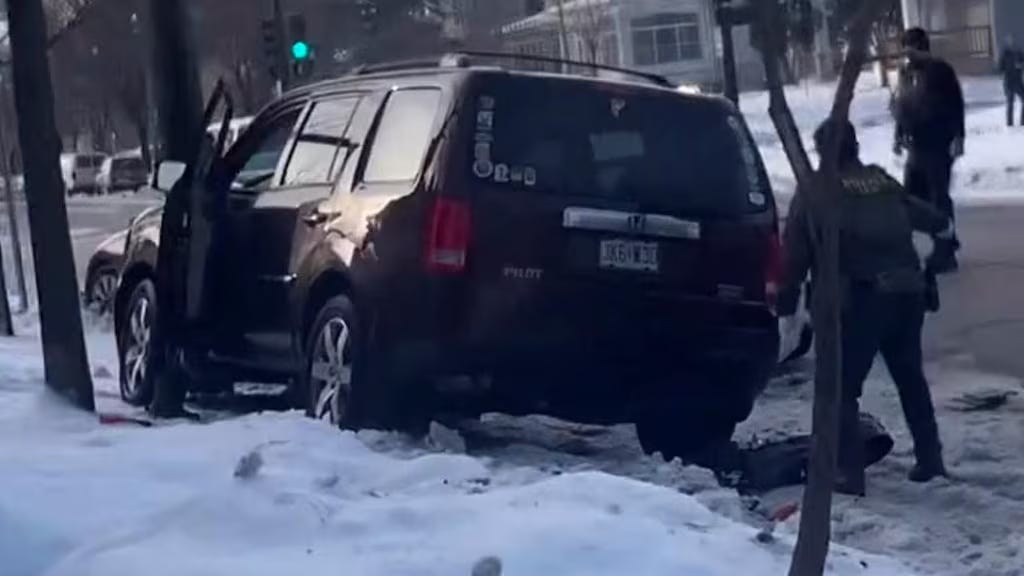
warning: the following piece will describe the events of the video leading to the murder of Renee Nicole Good. If you’d like to skip the re-telling, begin at the fourth line break: “The video isn’t complicated…”
When I first witnessed the murder of Renee Nicole Good, I had no idea what it was I was about to see. I’d just started on the treadmill at my gym, with my phone propped over the little blinking timer display, and was hoping to pass ten or fifteen minutes scrolling through Instagram videos of watercolor tutorials.
I had no context, hadn’t read any captions or reactions, and hadn’t yet seen the four text messages from friends warning me that every corner of social media was about to be dominated by the graphic final moments of a young mother’s life.
Before I knew what was happening, the video popped to the very top of my feed.
I watched as a woman’s hand stuck out from the driver’s side of her SUV, waving through traffic on her left side. I watched as two masked men in tactical vests jumped out of their approaching truck and walked to her door. I watched as one of them pulled on the handle while he reached in her open window, attempting to get to her. I watched her reverse in fear as another masked man crossed in front of her, grabbing his weapon from his hip. I watched that man fire once through her windshield as she was already turned to her right in an attempt to flee. I watched him fire again through her driver’s side window. I watched her car roll to a stop as her widow screamed. I watched a murderer walk away.
The video isn’t complicated. I did not watch it a second time. I knew what I had seen.
And as we all learned details in the following hours, I also thought I knew what would happen next:
The passing on of responsibility, the blaming of “inadequate training,” the “paid leave” while an agency investigated itself.
But that’s not what happened.
What happened instead was a wave of voices arguing that we hadn’t seen what we all definitely had.
The most powerful people in our country were telling us that we hadn’t seen a murder, no. We’d seen a brave man execute his top tier training perfectly. He acted appropriately, bravely even, and had barely escaped with his life.
This time, I did watch the video again.
No, that’s not what happened.
I know what I saw. What we all saw.
More surprising than the spin was just how many people seemed to agree. A chorus of witnesses to a horrifying murder who swore with straight faces that they had seen something completely different.
This wasn’t a difference of opinion, a matter of differing values or perspectives. This was objective reality.
What was happening?
I’m not a neuroscientist or a psychologist, so I can’t reach deftly into the depths of the human psyche for a clear answer here, but I was a teacher. I spent twelve years as an educator of critical thinking and media literacy, and the more I thought about it, the more I understood.
So while I can’t say for sure, here’s what I think might be happening:
5. They do not trust themselves
When artists are first starting out, one of their most important early lessons is not to represent what they think they see or what other people have told them they see, but to look with their own new eyes at the world around them. This is why novice painters stick a round yellow sun in the left corner of a blue sky that ends in a hard line against the green earth– they are painting what they think they know instead of asking themselves what do I actually see? There’s a similar idea around truth in journalism, when writers are told: if one source tells you it’s raining and another says that it’s sunny, your job isn’t to quote them both, it’s to look out the f*cking window.
Both of these ideas are rooted squarely in self trust. There are a lot of people who are incapable of trusting themselves, who will hold off on a perspective until they hear what other people think. This is different from learning and growing through the viewpoints of others, which still retains a strong core sense of self. It’s rooted instead in shame, in a lack of self worth, and a detached values system. Self trust isn’t something that exists only within one political party or another, but existing without it makes it a lot easier to slowly drift from a defined moral center. When we outsource the trust we should have in our own experiences, when we believe that we are too cloudy or unworthy or fallible to know what we’re seeing and feeling, it’s much easier to harness our doubt for nefarious purposes.
4. They have unquestioning trust in authority
So if we can’t trust ourselves, who do we trust? For a lot of people who carry the weight of crippling self doubt, the answer is almost always an authority figure. For those of us who have been trapped in the net of an abusive relationship, especially in our youth, the narrative is a familiar one: I must be missing something. They must be right. They’re smarter than me, have more experience than me. I trust them to know what’s going on.
The disconnect between felt reality and the presented narrative has got to be a disorienting one. But the presiding authority figure in the American conservative world (that is, Donald Trump and co.) has been microdosing his followers with greater and greater untruths over the last decade, each just a little larger than the last. What started as pea-sized pills of bullshit (a crowd size at an inauguration, the trajectory of a southern hurricane) have been slowly graduated past stolen elections and Capital insurrections. Anyone who’s left at this point has been carefully trained to swallow anything presented to them. The last act always would be, as Orwell put it, to “reject the evidence of their eyes and ears.”
3. They are falling victim to the “anchor bias”
Our brains don’t like being wrong – it’s kind of how we’re wired. Our noggins prefer the comfort of a sure thing, of the rigid blanket of an unchanging neural world. Unfortunately, we are wrong all the time, which is why it’s so important to practice cognitive flexibility. But it doesn’t come naturally, and if our egos resist too hard, we fall into the trap of what’s called the “anchor bias.” The anchor bias is our tendency to latch to the first bit of information we hear and then never ever ever let it go. So if we, say, hear from an authority figure that a brave man of the law defied certain death and rightfully deflected the attack of an unruly agitator (and we don’t often practice cognitive flexibility), we might just decide that no matter what we see or hear, we will believe that forever.
The anchor bias has a best friend, and his name is shame. There is a prevailing belief, especially in more traditionally masculine spaces, that changing your mind is shameful and weak– that it’s the result of brittle moral character. That is nonsense. What’s weak is a lack of curiosity. What’s weak is being unable to hold authority accountable. What’s weak is doubling down on cruelty and rejoicing in pain. That is real weakness.
2. They’ve been training to dehumanize us for years now
If there’s one through-line in all of the buzzing discourse from the right about Good’s murder, it’s that none of them seem to agree about why it was justified. It was justified, of course, they say. But why? In the hour or two after it happened, the prevailing argument was that the man who murdered her did so to save his own life. He’s “recovering in the hospital,” Trump said, and it was “hard to believe he is alive.” But that wasn’t true. He never went to the hospital, and the vehicle never struck him. Soon, the narrative shifted. She should have complied, they said, with the conflicting instructions given by the men who approached her. Pundits on conservative networks pointed to the “pronouns in her Instagram bio,” and lingered on her queer partnership.
It’s clear that the details of the incident don’t actually matter. This week, videos have been emerging of ICE agents taunting protestors with threats that they might be next. Citizens are being arrested through car windows, at the front doors of their homes as agents march from house to house, and for recording in costumes on the street. This is coming at the tail end of a years’ long campaign to strip us of our humanity. The question isn’t if we deserve it, but when they will get the chance to follow through on what they already know we deserve.
1. If they pull a single thread, the whole sweater falls apart
Really, the root of all of this seems to be fear.
Because what if Renee Nicole Good is exactly who she appears to be? What if she really was a scared young mother who presented no real threat to the three masked, armed men around her? What if the woman who was on that street with her dog, her wife, and a glove box filled with stuffed toys was trying to peacefully observe, and the man who called her a “f*cking bitch” after he shot her was the dangerous one? What if he should have never been given a gun at all? What if the authorities who are protecting him now are lying about what he did? If they’re lying about this, what else could they be lying about? Is the ICE occupation of Minneapolis even necessary? Is the danger they’re supposed to be protecting us from even real?
And that’s a lot to be afraid of.
As I read my list back to my husband who stood in front of our small kitchenette, he nodded along in silence. There isn’t a single thing I’ve published in the last three years that didn’t first go through Xilo. He acts as sounding board, cheerleader, and challenger (the trifecta of feedback), and I take what he has to say with deadly seriousness.
“I’m interested to see how you end it,” he said.
“Well that’s it, that’s the end,” I said, physically exhausted and emotionally depleted.
“No,” he told me. “What do we do now? You can’t just leave it there. Where’s the hope?”
And honestly, I’ve never struggled more to find it.
Because I might think I know where this disconnect in reality is coming from – the divide that surges like an impassable river between them and us, but that doesn’t mean I know how to bridge it. In fact, I’ve never felt smaller, and less capable of building bridges.
I thought about Renee, who seemed to keep her heart and her smile until the very end. Who, more than five years ago, wrote a poem that reached through time that made me feel connected to myself again. So that’s what I’m going to do. I’m going to keep writing, and making, and forging a legacy for myself that is rooted squarely in that kind of love.
Also, I made a tattoo appointment.
In just a few weeks, I’ll wear Renee’s words on my arm, to try and remember why any of this is worth fighting for, and why I will always be capable of love despite it all.
“maybe there in-between my pancreas & large intestine is the piddly brook of my soul.”
Because of the things you've written and shared I knew Xilo would ask "where's the hope?" even before I came to that in your text. And in that moment, I felt hope. Looking for hope in solidarity is hope manifested! Signed, an English teacher who loves you both!
Brilliant analysis. I’ve known the role that fear and shame play, because it’s played the same role in crowd control for millennia. But I love how you connect it to lack of self trust. Thanks for sharing.