

Actually, Nolan IS kind of making a point about trans people
And I have the (ancient) receipts

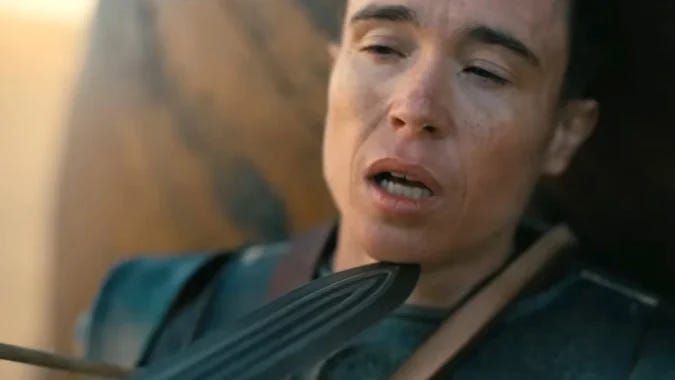
Massive 3000-year-old spoilers ahead (and some newer ones too)
When Elliot Page was first confirmed for a role in Christopher Nolan’s Odyssey, transphobes from across the globe lost their goddam minds. This was, partly, because initial online chatter assumed he would play Achilles, a character who doesn’t actually appear in the Odyssey (aside from a brief moment in the Underworld), and is actually dead for a big chunk of the Trojan War. Even before we had any real information about the realities of the film, a lot of us (rightly) jumped to Page’s defense. Trans men are men, and they can play men in movies, we said. Not every role we take has to be about *being trans.*
I still believe this, but my opinion has shifted since I saw the film for myself on Sunday.
Oh shit, I thought, as I watched Homer’s epic unfolding in a way I didn’t expect. I think this might actually be a little bit about being trans.
I’m gonna back up for just a second here.
So Achilles isn’t in the Odyssey. But Sinon, the character Page does play, isn’t in the Illiad or the Odyssey either. He’s in the Aeneid, which was written by the Roman poet Virgil sometime between 29 and 19 BC. While the Aeneid tackles a lot of the same events, the original text was not in Greek, was not written by Homer, and came out centuries after the original poem. Virgil takes a Roman perspective on the story, and has not always super nice things to say about the Greeks. He makes a point to paint them as treacherous, and Sinon is one of the ways he accomplishes this.
As a character in the Aeneid, Sinon doesn’t just convince the Trojans to take the giant wooden horse into Troy, he pretends to be a deserter of the Greek army and a fellow Osysseus-hater. He’s a big liar who lies, and he lies so much that he even shows up as a character again in Dante’s Inferno another 1300 years-ish after the Aeneid. There, he is punished in the eighth circle of hell for being a fraud and a big ol’ liar, doomed for eternity to a high fever (and not just a fever – it’s a fever that makes him stink). He also bitches about his fate to anyone who will listen. For eternity.
There is literally a word – Sinonical – invented in the 16th century to mean cunning betrayal and deceit. There is exactly one thing Sinon is known for in the Western literary canon: lying.
So why is he in this version of the Odyssey at all?
Christopher Nolan not only added him into a story where he didn’t exist for hundreds of years, he made him central to the guilt and growth of Odysseus: the principal character of this whole story. Nolan inverted everything Sinon has ever represented, flipping him from whiny, deceitful, and eternally punished, to a symbol for Odysseus’s personal shame.
After my screening of the film was over, I ran home to my own copy of the Odyssey– not to look for a living Sinon, but a dead one.
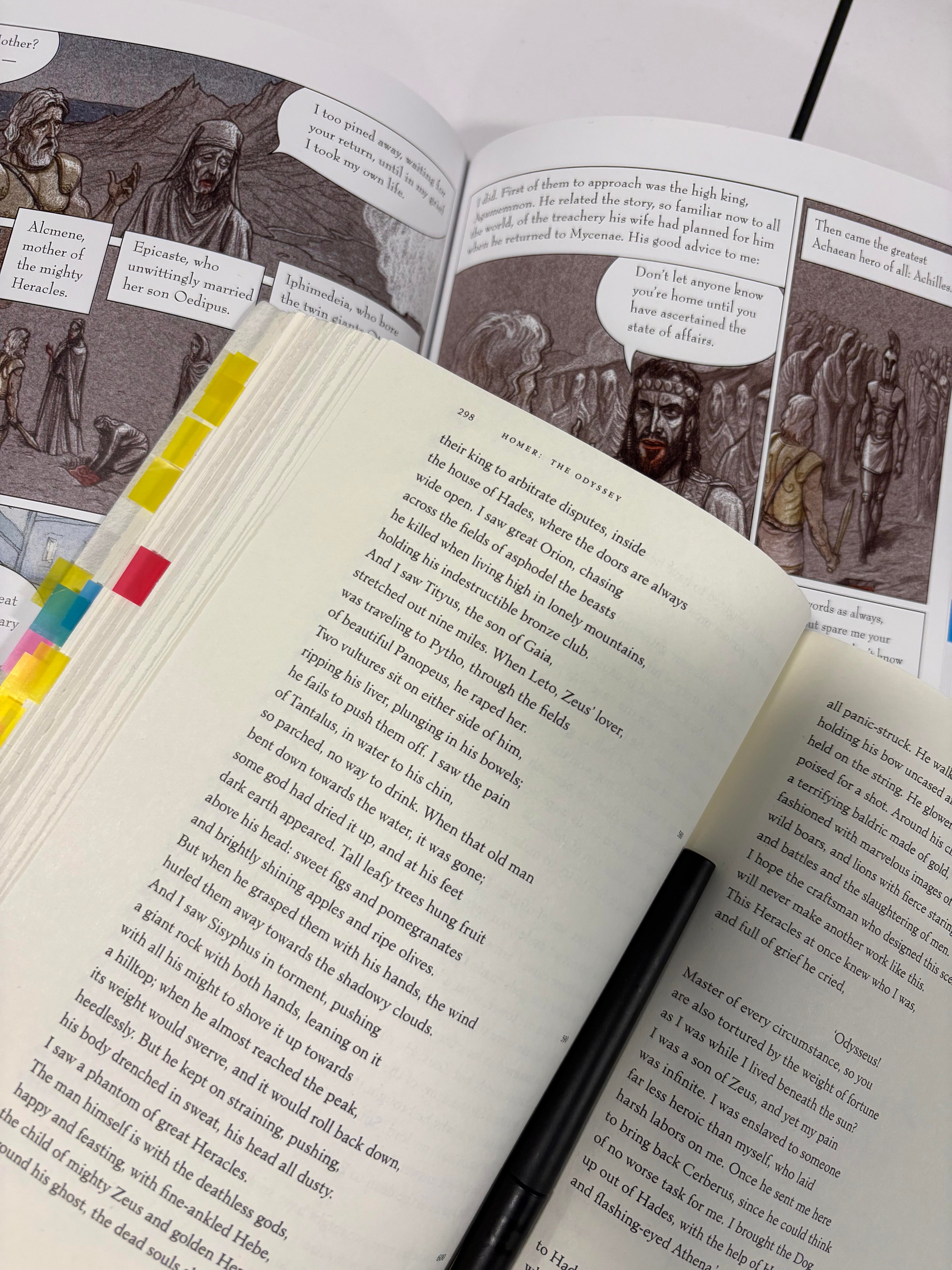
In the OG epic, when Odysseus journeys to the Underworld, he talks to just about every dead Greek he can think of. Yes, he summons the blind prophet Tiresias to learn how he can return home (who, as a side note, canonically lived seven years as a woman, but that’s a different article) and the king Agamemnon (famous now for his unmatchable golden-spine-helmet battlefield aura), but he also talks to his own dead mother, a soldier of his who fell off a roof, like, yesterday, Achilles, Ajax, Hercules, and a host of other famous Greek warriors. Completely missing from his underworld meet-and-greet? Sinon.
I don’t think this was an accident.
In the film, the scene in the Underworld is where we learn that Sinon was not a great deceiver, but a kid who was used by powerful forces to execute a plan that intentionally kept him in the dark. If there’s a villain here, it’s Odysseus, who uses Sinon as bait and sacrifices him to win a war.

This reveal is a double gut punch when paired with a flashback confirming that Sinon isn’t supposed to be on that Trojan beach at all. In another Nolan invention, we see young boys lined up to draw lots as Ithaca prepares to ship half of their young men away to fight in the Trojan War. A young Sinon draws a lot to stay home, while Antinous (later to be Chief Douchebag of the suitors) draws a lot to leave and fight. Antinous attempts to trade with Sinon, and Odysseus notices. Instead of punishing Antinous, he allows the trade, likely because Antinous has outed himself as a coward. No one needs a coward fighting beside them on the beaches of Troy.
But by making this choice, and then another ten years later, Odysseus dooms Sinon twice.
Sinon isn’t a coward or a liar. He is sincere. He is innocent. He was forced into a conflict he didn’t ask for.
If we want to see it, there’s something very powerful buried here.
First, for trans people like me and Page, there is nothing our haters love to call us more than liars. Prominent far-right voices like Candace Owens (who has called trans identity a “lie” on uncountable occasions), Ron DeSantis (who has characterized using our names and pronouns as being “complicit in a lie”) and just about every Republican with a microphone at some point over the last ten or fifteen years, have used their platforms to paint our community as one full of deceivers and con artists.
If Nolan did this – casting one singular and conspicuous “out” trans person in a role that has been defined for more than 2000 years as the face of treachery and deceit while simultaneously flipping that narrative completely on its head– and it was an accident? That feels too large to be a coincidence. No way.
But I think it’s also deeper than that.
How this character is used to inform the narrative matters too. Page is only on screen for five minutes of the total three hour run time, but his ghost haunts the entire story. Sinon’s name is always on Odysseus’s lips. He uses it as a pseudonym when he returns home, and he carries the lot that doomed him as a grounding totem throughout his journey. It’s clear that his betrayal of the boy he unfairly carted off to war is one of his deepest regrets, and he is tortured by the memory of Sinon’s sacrifice.
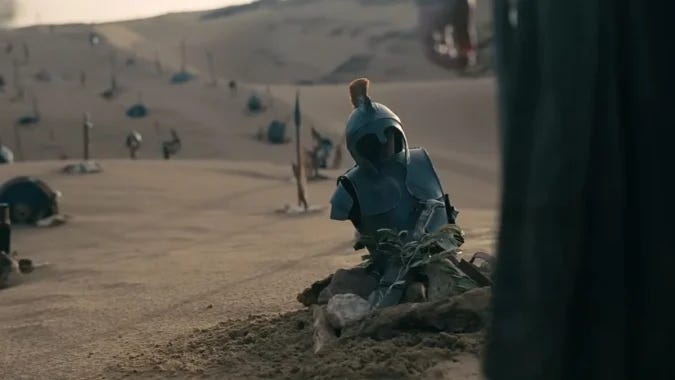
This part of Sinon’s story feels like a direct parallel to the way the powers of the western world have been using trans kids for decades now. They, too, have been drawn into a conflict outside of their control. They have been unwitting participants in a war that is using them on purpose and without their consent. Their healthcare, their education, their autonomy – their whole lives are being volleyed and mangled on a near daily basis for the benefit of small cowardly men (and women).
And it’s not just conservatives– it’s not just the enemies behind the gates of Troy. The primary villains might be the ones with the spears, but someone had to first leave them behind.
I think of how quickly so many Democrats left trans people on the beach once the pushback against us began. I think of the “I’m Gay, Not Queer. It Matters” NYT Op-Eds and big-name politicians who started to turn their backs on us when their designs for political power began to grow.
Sinon’s story, to me, feels like a warning. Abandoning the trans community has a price. We aren’t a shame that can be buried forever. The pendulum will swing, and we have long memories.
The most satisfying moment of the film, for me, came right near the end. It wasn’t Odysseus’s triumphant firing of his hunting bow or the final battle against the suitors, but a short monologue delivered from Odysseus to Antinous, where he fulfills a promise he made to a dead Sinon years before. He draws out the traded lot– the one that doomed Sinon and saved Antinous– and shoves it deep into the mouth of the man to whom he promised to return it. “I give you back your shame,” Odysseus tells Antinous in the final moments of his life.
And I think (I hope) that one day, the rest of us will have that moment too.
Excellent. I also very much appreciated "He was the bravest man I ever knew." Not a throwaway line I think.
Thank you for this beautifully articulated piece.